Showing posts with label money games. Show all posts

Tuesday, 14 January 2014

Frugal Fun with our Interest Beater Challenge

This will Test your Will Power

In 2007, I began the Billy Can Plan to help generate extra savings and then, in 2008, along came the Interest Beater Challenge. To celebrate 5 years of interest beating and 15 years of assorted money challenges, we're having a creative makeover.

For those of you who haven't had the chance to read all about it in the Frugal Forums this is a bite-sized. photo roundup of the 2014 challenge to beat the interest rates (shouldn't be too difficult in the current economic climate) and earn ourselves a better rate of interest than any of the instant access, cash ISAs are offering WITHOUT needing money in the bank.

STEP 1 - Go get your old Billy Can
(It's time he brightened up a bit, don't you think?)
 
 
STEP 2 - Turn it into a Frugal Faberge-esque Billy Cans!
(Beads, buttons and recycled greetings cards)
 
 
STEP 3 - Prepare this year's notebook & diary (or add more pages to your old ones)
(This is the Frugaldom cash cow notebook, it can keep an eye on all the savings)


STEP 4 - Decorate your magic money box
(Recycled Christmas cards and shiny buttons can provide the basics)
 
 
STEP 5 - Pop a penny in your Mo(ney) Jo(urney) bag
(No excuses for losing your mojo now!)
 

That's it - 5 simple steps to preparing for this year's interest beater challenge and, as usual, it is totally free to join us in the forums and take part.
 
See you there!
 
NYK, Frugaldom

Saturday, 11 January 2014

Frugal Bytes - Moneysaving Questions from Readers

Reader Questions about Money Saving and Frugal Living

Hi NYK,

Pennies make pounds
This seems a bit rude to ask, but as the saying goes, if you don't ask, you don't know! So apologies up front.

How did you manage to save your emergency savings?

Do you keep your 'emergency savings' separate from other savings?

Would you recommend a certain amount for emergencies?

Any advice on this would be gratefully appreciated!


NYK Answers

I love questions and am forever researching 'stuff', so thank you for asking and rest assured that I don't find it rude in the least, it is a huge pleasure to be able to answer. Apologies if I waffle on a bit, I'm rather passionate about frugal living. :)

Many years ago, while in debt, I got together a bunch of friends in similar situations and we compared our budgets. At that time, we all had very different household incomes, ranging from under £10,000 to over £30,000! The amazing fact that I learned from what became a regular get-together was that we practically all had the same amount of disposable income after paying everything we owed - mortgages, rent, council tax and all other debts!  It was amazing! The magic number worked out at £4,000, so that's the origin of my target budget. Now, in 2014, the figure is simply the amount I know I can comfortably live off and be happy to do so. It's also the minimum amount that I know I need to earn in order to live debt free! If push came to shove, I have sufficient flexibility within that budget to make alterations and also afford the Council Tax.

After living on the £4,000 budget for many years, the debts slowly and painstakingly reduced until, in 2007, I finally became completely debt free. At that point, I had two options for remaining debt-free:
  • Live within my increased means or
  • Continue as though I still had the debts, but pay the equivalent amount into savings. (At that point, I had no savings.)
2008 arrived and I had decided to stick to my previous budget and frugal lifestyle while starting to seriously save. (That's when I took the 'Living on £4,000' challenge onto the Moneysavingexpert forums.) With no debts, every penny over £4,000 got banked and all other spends had to be paid from extra income or else things made to pay for themselves.

Fast forward to 2011, we scraped up enough to buy this cheap fixy-up for cash, but it completely wiped out every penny of the savings - my son even chipped in all his coin savings!
Plus point - we had no savings left but nor had we any rent to pay, just council tax and insurance for our own house.

Sticking with the £4,000 household budget, we are now slowly renovating the place while also saving for emergencies. I know I need £4,000 to run my household for a year, I know I realistically need another £1,000 to cover Council Tax and I know that incidentals may be needed along the way, so my goal is to have at least £5,500 in emergency savings and increase that by at least the rate of inflation each year, seeing as bank interest no longer affords us that luxury! THis, again, is what has prompted the latest edition of the Interest Beater' challenge in the forums.

Emergency savings are totally separate from 'normal' savings, so no mistakes can be made and I can't be tempted to spend from this pot. Initially, I needed to invoke all my will power to ensure every penny was saved. In saying that, I am using an instant access ISA, 'just in case'.

I hope this helps explain the way I view my finances, both in the frugal forums and here on the blog.

Feel free to continue asking questions and I do hope you will join me in the latest frugaldom challenge, as we hatch another great Billy Can plan and prepare to do some money magic.

NYK, Frugaldom

Wednesday, 27 November 2013

1999-2014 Celebrating 15 Years of Frugal Living Challenges

My Moneysaving Experience Has Taught Me Well!

Frugaldom's Annual Frugal Living Challenge

It's the time of year when we all need to start thinking ahead into the new year, especially if we need to tackle any debts, generate extra income or squirrel away some extra savings for something special.
 
Scottish pound note
Scottish pounds - still in circulation
2014 is a very special year for NYK - it will be the 15th anniversary of our frugal living challenges. (We did have challenges prior to that, but of a slightly different variety.)

Every year, I set a Frugal Living Challenge, based on the original concept known as 'The Scottish Pound'. The following is clipped from a 1999 newspaper and shows the beginnings of our first, ever, published grocery challenge. For the benefits of non-Scots, the word 'messages' basically mean groceries.

NYK Media's first published grocery challenge from 1999

The grocery budget has increased, somewhat, since 1999. Currently, the Frugaldom household grocery budget is set at £1 per person per day for all meals. In saying that, I have maintained the same overall annual budget for many, many years, so my £4,000 per year challenge is still the one I, personally, follow. Nowadays, I'm probably getting far more for my £4,000 because some luxury non-essentials cost much less.

Life experience (and a 1997/8 challenge) taught me that almost all things are possible within a budget, as long as we are realistic about wanting to achieve our goals and live well within our means. By following a few basic principles (and almost every trick in the book) I managed to clear my feet by 2007, but continued running the challenges, multiplying and diversifying them along the way.

I love trying to beat the banks, squeeze overhead costs and attempt what some consider to be impossible while stretching every single penny of my budget as far as is humanly possible! Year on year, we try to grow more, make more, save more, need less and waste less. The quest for self-sustainability is still as relevant now as it ever has been, in my opinion.
 
A budget is a very personal thing; it should fit with your personal financial situation and it should enable a decent lifestyle to be affordable. No two households are identical, so work out your own cost of living and your own household budget. If you aren't too sure how to do that, you can check out What is a Budget?'

Some followers of NYK and Frugaldom have already achieved their debt free status and moved on in their worlds, while some now follow our challenges simply to help them remain free from debt. Others are still pursuing that dream. Whichever stage you are at, feel free to join us for 2014. Share your journey with like-minded others in the Frugal Forums.

Now we are approaching December 2013 and preparing to launch the 2014 Frugal Living Challenges, which will be hosted in the Frugal Forums. As usual, some will also be featured elsewhere in various guises. We do like to spice things up a bit now and again, so we incorporate mini challenges lasting anything from a few days to weeks or months.

The final monthly-challenge of this year is Decius Frugalus! For the entire month of December, we will be practicing our creative, moneysaving, frugal lifestyles with an attempt at zero-waste on cash, energy, food and fuel in an attempt to leap into the new year full of renewed hopes, dreams and ambitions.

They may take our money but - once achieved - they may never take our debt freedom!

For some it is initially about asking themselves the question, 'how did I get into debt'? That is generally followed by the all too familiar, 'how do I get out of debt?' and, as soon as that penny has finally dropped, you should feel some of the weight lift off your shoulders. Clearing debt isn't easy, but nor is it impossible. If you want to be part of a mutually supportive and rather exclusive group of like-minded people, introduce yourself in the Frugal Forums.
 
For others, our challenges are about increasing savings, buying property, becoming stay at home mums, starting businesses, seeing the world or paying off the mortgage early. Some choose the lifestyle on ethical grounds but it is not, as has been suggested in the past, self-imposed poverty. It's a fun and supportive way to help you manage your budget, enabling you to control your own cost of living. It's also about separating the NEEDS from the WANTS.

In case you should ever run a little short of free reading material, the following links will take you to previous versions of this challenge that have run on the Moneysavingexpert.com website. It's a no holds barred look at reality in a virtual world:


Thursday, 21 November 2013

#Win with NYK - What Type of Savvy Shopper are You?

What Type of Savvy Shopper are you and what are 'Freedom Rewards'?

coins

I’m a Bargain Hunter Gatherer and proud of it!

Frugaldom is giving you the chance to learn about Freedom Rewards while taking a short quiz to determine what type of savvy shopper you are, plus the chance to win £60 of Amazon vouchers, courtesy of our sponsors at Barclaycard. 
A new consumer study carried out by Barclaycard - which processes nearly half of all card transactions in the UK – together with consumer experts at Brunel University, shows that the recent economic climate has made a lasting impact on how we approach shopping and saving money. Bagging a bargain goes far beyond just saving cash, people now place far greater value on the emotional investment of smart spending, giving rise to our four new modern shopping 'tribes'.
  •  The Bargain Hunter Gatherer
  •  The High Street Pounder
  •  The Screen Saver 
  •  The Profit Prophet
I took the quiz and am pleasantly surprised at how accurate the results are! Now it’s your turn to see what you think and share your views. An extra £60 to spend is a much appreciated opportunity and, thanks to our sponsors, we have just that!
 
Take part in the quiz here

Edited in: Results of the free draw can be found here

(Original image URL: http://www.flickr.com/photos/mukumbura/4052671706/)


Tuesday, 12 November 2013

How to Make a Frugal McGonk in 10 Easy Steps

How to Make a Frugaldom McGonk

Some people accuse us Scots of being mean, but we prefer to think of ourselves as frugal. We try to lead a 'waste not, want not' lifestyle, here at Thrift Cottage, so every little bit of anything counts in the quest for frugal fun.

If you have anything left over that can be made into something else, then it can be rather fun getting crafty and making the most of what you've got.

I hope you find these easy to follow instructions fun and helpful. With the festive season almost upon us, why not add a bit of frugal fun to your decor or make a few little gifts for friends and family.

How to make your very own McGonk using nothing more than bits, bobs, scraps and offcuts.

MATERIALS

- Read more here

Thursday, 7 November 2013

Another 26 Hints, Tips and Suggestions to Help you Save Money

Being Prepared for Frugal Living


Before we begin, let's get just one thing straight - moneysaving does not mean being mean, nor does frugal living. It's true that it is about living a more simple lifestyle and trying to be more frugal in a self-sustainable way, but this doesn't mean you need to sell all your possessions and move into mobile accommodation or live like a nomad. Despite this 'free of the rat race' sounding escapade, it isn't actually all that practical in our modern society, so we need to face facts and do the best we can with what we've already got. If unsustainable debts are what you've got, then your primary concern should be to get rid of them as quickly and painlessly as possible, even if it means one screaming penny at a time.

So, to follow on from my previous post of '20 Hints, Tips and Suggestions to Help you Save Money', I thought I would continue in that vein and post another 20, seeing as there's such an endless supply of things we can all do to help balance our own budgets.
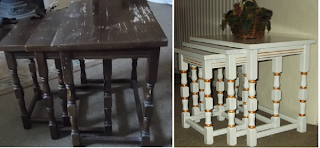
Old nest of tables - before and after a frugal makeover.


 1. Recycling and upcycling can be much more fun than binning, burying or burning what's past its best, so I'd suggest taking a much closer look at anything that you think may need replacing soon, whether it's furniture, clothing or major appliances. Can any of it be fixed up in a way that changes it for the better? Can one thing be made into another? Can you create space for storing useful stuff? Even a neat pile of decorated cardboard boxes can look great when stacked in a corner of a room.
 
2. Vacuum Cleaners - Have you considered using a brush and pan occasionally,  instead of vacuuming? Modern vacuums can have motors well in excess of 2000w and that means it can cost you the best part of 10p every time you do quarter of an hour's vacuuming about the house!
 
3. Ironing can cost you over 20p for an hour, so why press everything when it doesn't need done? Air dry whenever possible and then fold it neatly to put it away before it gets crushed. Only the absolute essentials should need a quick press to make them presentable and there's always the old 'mattress trick' of lying jeans flat underneath for an overnight. Edited update - having checked the new, top of the range steam irons, I see some are 2800w. Once we factor in the standing charge for our electrical supplies, a steam iron set on high could cost some of us closer to 50p for an hour!
 
4. Hairdryers can be more powerful than some small electric heaters! Anything involving heat provides evidence that it's a big guzzler of energy, so just towel dry your hair and brush or comb it dry. If you are up to your eyes in debt, a posh hairdo won't make the finances better.
 
5. Vinegar Hair Rinse - A homemade vinegar rinse can put a shine on your hair and help keep the tangles at bay. Keep a jar made up handy by the sink. 2 cups of white or cider vinegar mixed with a few drops of your favourite essential oil can be stored in a glass jar then simply dilute about a tablespoon of the liquid in a cup of water to use in the final rinse. No need to blow dry, as allowing your hair to dry naturally helps give it more sheen.
 
6. Egg Hair Conditioner - Beat an egg yolk (not the white) with a tablespoonful of olive oil or baby oil and then mix with a cup of warm water. Use this to condition your hair as and when required. Use the egg white to make the micro-meringues included in the Frugaldom Food and Fun card sets.

7. Buying candles probably works out more expensive than investing in a wind-up torch for emergencies, but candles are, nonetheless, very handy to have during power cuts, especially if they are the only source of heat you have for warming your hands! Add them to your gift list in case anyone asks what you'd like. Practical gift are always more appreciated by we of the frugal lifestyles.
 
8. Grocery shopping - Why buy 2 for 1 if there is even the remotest chance that you could end up throwing the extra in the bin? Why not share shopping with a friend and each of you have one for half price?
 
9. Walking - Probably the cheapest form of transport but it needn't involve expensive footwear. With a bit of forethought and planning, it is possible to get a full year of travel out of one pair of boots for less than a tenner - just keep them clean, dry and supple after every outing.
 
10. Dressmaking patterns - Clothing is another big spend for many families, especially where children are concerned, but dressmaking doesn't need to be about fancy fabrics and making dresses!  Can't sew yet? Take the time to unpick an old item of clothing and there you have it - the correct pattern to copy and remake in your own choice of fabric that can be altered to size it up or down accordingly.

11. Simple sewing - Start off turning an old pillow slip into a reusable shopping bag, laundry bag, dumpling 'cloot' or even handkerchiefs for practicing your embroidery and you'll soon get into the swing of needlework. Save your oldest pair of jeans for cutting patches to embellish and strengthen subsequent pairs 'designer' fashion.
 
12. Growing your own - All you need is a sunny windowsill, a doorstep pot or a tiny corner of a garden - yours or anyone else's to get started. If you use herbs in your cooking, look out for bargain packs of fresh, still in the pot, supermarket special offers. These can be cut and will continue to grow and grow... my herb garden is full of such plants. Sprigs of rosemary will root easily in a glass of water and can then be transplanted into a pot on a windowsill for perpetual use, taking more cuttings each year it grows and then potting these up to give as gifts.

If you have the space, other food you can try growing are seeds from inside things like pumpkins (although pumpkin seeds can also be roasted for eating on their own), tomatoes and peppers, fruit pips, garlic cloves and even potato peelings. The root end chopped from spring onions can regrow more spring onions, the base of a celery can regrow more celery and the base of a cabbage or lettuce can grow more cabbage or lettuce. Nature is on your side in this game, it just needs fresh water to help it get started.
 
13. Reusing paper products may not sound like much but, over time, pennies add up into pounds. By stashing away all those envelopes, junk mail, cards and calendars etc. you can then try decoupage, handmade cards, papier mache (have you seen Penny the Penguin, Phil the Pig or our Cash Cow animal banks?), paper pots for seedlings, kindling for a fire, shredded bedding for pets, dry material for adding to compost bins, as a temporary sealant for draughty windows, for pattern making, homemade wrapping paper and, lest we forget, how many uses can one person find for cardboard inner tubes from toilet rolls and kitchen rolls? Homemade Christmas crackers anyone?

14. Chopping, slicing, dicing and grating - I'm not suggesting skimping on food to what's less than needed but, as a simple way of controlling portions to healthy levels, it is ideal. So many of us (myself included) tend to over-eat without being aware of that fact. I had no concept of what the Government health organisations recommend as sufficient by way of quantity of food served until I tried weighing things. Try weighing out 30g of breakfast cereal to see how it compares to your normal hapless servings and then you'll see how much further food would go if we restricted the portions to what's now said to be enough.

15. Cooking - add as much as possible to the one pan to cook a meal for less. This also ensures all the flavours are retained and shared, bringing a little extra creativity to your meals - never be afraid to mix and match - of course green beans will stir fry with onions and cucumber in your discounted sweet chilli sauce.

16. Alternative cooking energy - if you have a stove or log burner, make the absolute most of it. Low heat is slow heat, but it all cooks food.

17. Warm plates for warm meals - there's nothing nicer than a hot meal that stays hot even during the coldest weather, so warming the plates can seem extra special. For some, it seems an extravagance but why waste valuable heat if you're cooking up a meal anyway?

I can easily fit two large bowls or several smaller bowls over the top of my slow cooker, or on the top of my mini oven. so they get warmed up for free. Just use your common sense when lifting them.
 
18. Get Together - Organising family nights, date nights or social get togethers with friends and neighbours based around common interests is a great way of bringing extra entertainment into even the most cash-strapped household. It is especially helpful if you can invite others who, in turn, will host the next such event. A budget of £10 can easily provide sufficient snacks and refreshments for a party of a dozen. With some basic cooking or baking skills, you could hold a curry night, a traditional fare night, games night or even a themed party. Don't keep up with the Joneses - invite the Joneses to play along and take part in the challenge of hosting a get together on a £10 budget! Tell them it's 'the in thing' for trendsetters.
 
19. Charity Shopping - It isn't always about being skint, some folks shop in charity shops to actually help support charity! If you are decluttering, take along a few items to your nearest establishment and have a browse while there. Often, you can find fabulous items at ridiculously low prices, other times you may find crafting materials or cheap garments that can be turned into something else that you need - a duvet cover into curtains, for example. But a word of warning - remember nothing is a bargain if you aren't saving money on something you truly need.
 
20. Have a power out day once a week - probably best done during warmer months to begin with - switch off everything that doesn't absolutely need to be on and take a look at your lifestyle without electricity. Some people throw the main switch, disconnecting even their fridges and freezers so they know they're prepared for power cuts, but I don't subscribe to interfering intentionally with the running of appliances set to preserve food. What do you do? How do you get around the need for instant power? How do you stay warm if it's cold and the heating is off for 12 hours at a time? This is when you discover exactly why you knitted all those odd balls of wool into big, sloppy blankets.

21. Basic essentials in the kitchen - sugar is sugar but you don't need to pay a fortune for butter when margarine will do instead. In fact, there are some recipes that can be followed using vegetable oil or lard when no butter is available. Milk is something else you can save on, as inexpensive whitener can be used in coffee or tea and reconstituted powdered milk can be used in almost all recipes where milk is listed as an ingredient. Then there's UHT - it lasts longer, doesn't need refrigerated and costs less, in most cases, than standard pasteurised milk.
 
22. Just add dumplings! Yes, I said dumplings! They're a simple mix of flour, suet and water with a bit of extra flavouring if preferred - you can even add some of your home grown herbs. They beef up a stew, can be served with gravy for supper, taste great in mince and can turn a bowl of broth into a very filling meal for any hungry Horace. And better still, they seem to cook anywhere there's heat - on the stove top, cooker top, log burner or slow cooker.

23. Corner cutting cooking - Switch kettles off as soon as they come to the boil, cook using a 3-tier steamer so you use only one ring of the cooker and learn to make the most of a microwave, as it probably uses less than half the energy required to cook in a conventional oven. A slow cooker can be used to cook most things on low power over several hours, but it also contributes to the overall heat of your kitchen, helping save on that. A mini-oven costs less to use than a full size oven... you get my drift. Just as you shouldn't cook more than you can store (or eat), you should also ensure you fill as much space as possible when cooking, or else downsize the cooking space.

24. Take a flask - How often do you go places and then find you want a hot cuppa or a snack? Take it with you. Even if you don't need it, you can have it once you get back home. At best, you'll have saved several pounds on the price of a sandwich and a cup of coffee or tea while you were out and about. A picnic or snack pack is a meal for all seasons.

25. Know anyone who knits? Knitting can be an expensive hobby but thousands of people do it and many never finish all the balls of wool they buy. Volunteer to take it off their hands and then get your pins out to make yourself a bitsy, piecy blanket that can be the shabby chic envy of all your friends.  They may even ask you to make them one if they buy their own wool and pay you a token sum as gratitude. That's when they'll realise the price of yarn and appreciate the true cost of hand crafted goods!

26. The price of bread! It's getting quite ridiculous, so what do you do if you run out, don't have yeast or don't have time to bake a loaf? Bake a big scone or some tortillas! This one is a simple recipe given to me by a friend (thanks, T) when I was in a hurry to make a hot lunch. A big cup of flour, half teaspoon each of salt and baking soda and some milk to mix. This frugal soda scone, or farl, was enough to feed four when sliced through and served with melted cheese. I cook mine in a lightly oiled frying pan over the multi-fuel stove, so no electricity required.

Well, this began as a post containing another 20 hints, tips and suggestions for moneysaving but, as you can see, I've now numbered them and discovered I ran over, slightly. Oops! There are just so many ways to save money.

My invite to you:

Don't be scared to comment with your own suggestions - I am fully aware of the fact that after many years of looking at ways of making things affordable, I still have a long, long way to go and much still to learn. Go ahead, have your say here or in the forums at www.frugalforums.co.uk where we have a section about frugal living, plus several other categories all about debt-busting, money saving and even some money making challenges.

NYK Media, Frugaldom

Tuesday, 5 November 2013

20 Hints, Tips and Suggestions to Help you Save Money

How to Prepare for Frugal Living


As we fast approach the end of another year of challenging ourselves to living a productive yet frugal, life, many of us are turning, once again, to preparations for the new year. It may only be early November as I write this but the latest monthly challenge is under way - Novus Frugalus has begun! You can see how to take part here.
 It is a chance for newcomers to frugal living (frugalers) to give it a go, if you like, sampling the lifestyle before committing to taking part in our year-long challenge to cut costs and live well within our own means. It's much easier said than done, I might add, so I thought I would lay down a few hints and tips to help newcomers - 'novus' literally means 'new' - prepare for 2014. Are you sitting comfortably? You may be in for a rough and bumpy ride if you've never before tried this.

  1. Decide exactly why you want to make your lifestyle more frugal - is it a financial necessity for the purposes of clearing debt, a savings exercise so you can afford something special, a major cost-cutting exercise to help safeguard your own financial future or simply because you are so rich that you can afford the extravagance of being eccentric? (Believe me, it will surprise you how many people think this may be the case!) In the beginning, my reasons were for debt-clearing and then gradually graduated onto buying a fixy-up house without a mortgage. Now it is so we can afford to renovate the fixy-up and I'd like to think that within the next couple of years that I'd graduate further towards safeguarding my own financial future. As for eccentricity, well... I continually aspire to that and put in as much practice as possible! If all else fails, I shall simply make myself a big, floppy hat for my own retirement.
  2. Take a sheet of paper and a pen or pencil and draw a line down the middle of the paper. On one side write the heading 'NEEDS' and on the other, write 'WANTS'. Now take a close look around you at home and list what you can see in the appropriate columns. Needs are things that the human body simply cannot live without, whereas 'wants' are everything else. This, in itself, can be a real eye-opener once you see how little of the stuff that surrounds us has any impact on actual life. These are luxuries - whether it's a phone, a television, a games console, an electric gadget, cosmetics, fashionable shoes...
  3. Imagine a sudden and complete loss of income - it doesn't matter the reason, it just matters that you are prepared to ride out that financial storm because for many, this could mean disaster.
  4. List your outstanding debts - everything from the month's credit card bill, overdraft or loan repayment to catalogues, contracts, mortgage, membership fees, subscriptions, insurances and even regular savings plans that may be set up as regular standing orders or direct debits - if the payments are expected, then the companies and organisations concerned are going to attempt to collect them whether or not your income has stopped. If you don't have the financial wherewithal to cover them, banks and creditors are pretty rigid in their rules where fines, fees, penalties and increased interest rates are concerned. For how long could you cover your weekly or monthly outgoings if you suddenly lost your income?
  5. Declutter to make space for storing absolute essentials.
  6. Take advantage of bargains that can be stockpiled, but always remember that a bargain is only a bargain if you will actually use it.
  7. Learn the basics of home cooking - cooking from scratch can save an absolute fortune and let's face it - if you suddenly lose your job, that could provide you with sufficient time to learn a whole load of new stuff.
  8. Quit spending on anything that isn't 100% essential to life itself.
  9. Assess how much your current job costs you - few ever analyse these interesting figures, so fail to see that spending £6,000 extra each year to go and work in a £20,000 job is the same as spending nothing and walking to a £14,000 job, or even one that involves fewer hours. How much do you spend on work-associated expense once you count in cars (or other transport) child care (where needed), lunches, coffees, cosmetics, extra grooming, suitable clothing and all the other little things that add up over the space of a year? Every mile you drive costs more than the price of the fuel you put into the tank.
  10. Bin raking! This may sound like something the proverbial tramp on the street might do but I mean it in a slightly different way; I mean start looking at what is being binned in your household, because everything that goes into it has, most likely, been paid for out of your income. Even the packaging stuff comes in is paid for somewhere along the line and everything you bin is money wasted.
  11. Quit buying takeaways - how many meals do you make and how many arrive in the house ready-made by way of supermarkets, takeaways or fast-food drive-through type places? Basing costs on my own £1 per person per day for ALL meals, it is fair to say that the cost of a takeaway meal for one can cost as much as some might spend on groceries to make meals for the full week. Frugal living while debt-busting does not include buying ready-made food.
  12. Quit eating out - a single meal out in a hotel or restaurant can equate to a full month's worth of food supplies for one adult. Only the seriously affluent can afford to eat a month's worth of meal at one sitting.
  13. Quit non-essential habits like smoking, alcohol or any other drugs, for that matter - even sweets and certain types of fizzy juice can be perceived as addictive and rack up a small fortune of spends! They simply aren't worth it if you are serious about becoming debt free, solvent and financially secure for the long-term.
  14. Count up how much toilet paper your household gets through in a full year. This may sound ludicrous, but once you have calculated the true costs of what you're flushing down the drains, you'll understand the importance of being prepared to grab a bulk bargain when you see one.
  15. How many loads of laundry do you do over the period of a year and at what cost? I was horrified to see some laundry detergents costing as much as 40p per wash and then some folks still needing to add on another 10p per load in fabric conditioner/softener without including the electrical costs of running a washing machine and, perhaps also a tumble dryer. Yes, this is the top end of the scale, but dyed in the wool frugalers will be washing at low temperatures, using white vinegar as the basis for their fabric softener and a soap/washing soda mix as their detergent. (See how to make homemade laundry detergent.)
  16. Start saving good jars and bottles with screw top lids that will be suitable for jam, jelly, pickle and chutney making. Save plastic tubs for soup and other meals that can be frozen.
  17. Start looking at what you have from the point of view - could I make that myself? Even clothing can be handmade easily and cheaply once you know how.
  18. Get acquainted with your local charity shops, exchange trading groups, freecycling sites and like-minded others in your area. You might be surprised at how many are playing this moneysaving game and you'll also need an outlet for decluttering if you don't have the time or inclination to sell it to raise a few extra pounds.
  19. Set aside a corner and a box to keep all those handy crafting essentials together - the world of make do and mend is a rather fascinating one that can lead you in many directions. For many, it opens up a whole new side of life that involves crafting. Handmade can equally mean individually designed and unique. What designer label can offer you that and at what cost, I ask?
  20. If you need to spend, try to get cash or loyalty points back on all your purchases. Despite my living in a fairly rural location, I make the most of Topcashback, Approved Food, MuscleFood, Nectar card and a cash-back credit card.

There are so many ways to help you cut costs and save cash while going about your normal day-to-day life that no single post could ever cover them all. I'll post another list soon, so watch out for that. meanwhile, my suggestion is that you join us in the Novus Frugalus moneysaving challenge and take full advantage of everything that everyone has to offer by way of what they are doing in their own homes and workplaces, so you can prepare to launch headlong into a frugal lifestyle. It needn't be boring, nor need it be miserable, self-imposed poverty. Yes, it is a tough lifestyle to adapt into while desperately trying to claw your way out of a quagmire of debt, but the rewards are rich, in every sense of the word.
  • If you don't like admitting to cost-cutting DIY, refer to your exploits as hobbies.
  • If you don't like admitting to being skint, refer to it as austerity measures while saving for X, Y or Z - it was a good enough excuse for the Government!
  • If you can't get out of gym membership then make the absolute most of it - shower and wash/blow dry your hair before you leave.
  • If you don't like explaining to the kids why they can't go gallivanting with their friends to cinemas, fast food takeaways or whatever, make it fun for them - let them entertain at home on a budget
  • If you can't go a month without a visit to the hairdresser or beautician's, ask yourself some serious questions!
  • If you can't simply quit an expensive habit, start now and gradually phase it out between now and new year then say it's a New Year's resolution.
  • If you want something, make it affordable to your budget rather than over-stretching your budget in an attempt to afford the unaffordable.
 

Tuesday, 22 October 2013

Frugal Money Making Ideas

How to recycle games consoles, DVDs, CDs, games, books and even clothing for cash. I am looking for an easy option that doesn't involve travelling, waiting in for callers or listing in the online auctions - I want simple convenience and the ability to de-clutter or recycle for cash straight from home.  De-cluttering and Recycling for Cash  The process looks simple enough even for a technophobe like me. You just enter the make and model of the gadget or barcode of the DVD, CD or Game that you want to sell and click for an instant offer price. There are a few terms and conditions that need to be met but these seem to be basic common sense, so nothing too complicated. Read More here


Thursday, 3 October 2013

Barricades and Barack Aides

money

Closing Down Sale, Everything Must Go

I've been looking more at the current American situation with the Government shutdown and I think I now understand the basic principle. Feel free to correct me if I'm completely wrong!

Click here to read more

Saturday, 31 August 2013

Septimus Frugalus #Nonspender Challenge and a Free Giveaway

Septimus Frugalus Welcomes You All to a Free Giveaway and a Fun, Frugal Challenge this September.

 As announced yesterday, our September moneysaving challenge over at www.frugalforums.co.uk is about one month of frugal living - some handy hints and tips for newcomers, a few refreshers for us old diehards and an invite to try out the lifestyle that we all love. So, without further ado, let's get ready to frugalise the household budget and earn ourselves a handsome ransom by releasing the captive pennies from the bonds of consumerism.
 
Taking part in the challenge is completely free, you simply need to join us in the forum HERE and post to let me know to add your username to the list. All names on the list (barring my own) will be entered into our free giveaway.
 
I was trying to think of some easy examples of frugalising your budget, but was soon provided with a couple just by reading some of the responses. Here are a couple of really straight forward suggestions:
  • Newspapers offer discount coupons, such as £5 off a £30 shop at a particular supermarket, in the hope that we'll all dash out and spend £30 whether we need to or not. Why not use these vouchers to stock up on particular items that you would normally use throughout the year? For some items, £30 can be a full year's supply of stuff that doesn't go off - tins, dried goods, toiletries, laundry products, paper products, coffee, tea or discounted goods that can be frozen when you get home - and the free £5 could equate to a full year's supply of laundry cleaner, if you stock up on basic soap and washing soda. What you don't want to do is fall into the trap of spending the extra £5 on extras just because it seems to be free. If you must do this, I'd suggest you use the extra £5 for something that can be used as a gift for someone else - it's the £5 saved on Christmas or birthday gifts.
  • So what if your cupboards are bare and your freezer almost empty? This challenge is about making every penny count, so challenge yourself to replenishing the stocks by bulk buying, looking for the very best deals - remember it's all about price per gram, kilo, ml or litre, not about how many in a pack - and always keep a good stock of basic essentials for baking and batch cooking.
  • Be prepared to learn to love soup - it's one of the cheapest, most nutritious and cost effective meals there is in the frugal living menu stakes. (Likewise with porridge made the traditional Scottish way - with tap water.) You can make soup from almost anything. We have a thread about soup-making in the frugal forums and also several recipes included in this blog site.
That's it - the start of a new way of life for some, extra fun for others and, along the way, a few little extras just to make it more interesting. Nobody needs to be a gourmet chef, nor should they need to live on takeaways and fast food, we'll be having cheap, easy to cook meals that anyone can manage on a budget and we'll be helping one another along the way. We'll make do, we'll mend, we'll recycle, make, bake and budget wisely. All going well, we should have spent less, achieved more and maybe even have a few pounds left over to put towards winter and some festive fun.
 
Everyone is welcome to take part free at anytime, so bring yourself over to our 'Septimus Frugalus' challenge (http://frugaldom.myfreeforum.org/about1347.html) and have yourself some money-saving fun. Many thanks to all who have chosen to join us, so far.

Friday, 30 August 2013

Septimus Frugalus - September's Non-Spender Challenge

Monthly Challenges in Frugaldom

The names of the months confuse me, what with the 'Sept' meaning seven when its month nine, 'Oct' meaning eight when it's month ten and so on, but September is almost upon us and, whether we like it or not, it's month nine of twelve and we're fast heading into Autumn.
 
You can feel a definite drop in the temperature here in Scotland, to the point that the thought of lighting the stove crossed my mind. Shame on me!  Now wearing my cardigan, I will continue, safe in the knowledge that no fuel was burned and no unnecessary spending occurred. This is what prompted me into launching this September non-spender 'game' here in Frugaldom, by introducing you to Septimus Frugalus.
 
Septimus Frugalus is the epitome of money-saving; every penny is a prisoner and no matter what it is, if it's taking up space then it needs to either be growing, earning or contributing positively to the overall frugal lifestyle.
 
For the full month of September, we are going to do as the great Septimus Frugalus does - hold our  money hostage and clear out the deadwood that might otherwise be cluttering up the frugal living process. We're having a month-long spending challenge throughout September, based on not spending unless it is absolutely essential.
 
September moneysaving challenge
Click to go to the challenge
 
The main aim of this challenge involves a basic introduction (or refresher course) to frugal living and it should be of some help to our lovely new forum members and followers, in preparation for the 2014 Frugal Living Challenge.

 
Wastefulness is bad, in our frugal books, so the month of September is going to be a 30-day challenge to polish up our frugal skills. This will include assessing the contents of the kitchen, garden and/or food stocks every day in order to use up what is already there, rather than buying anything we don't actually need. It will mean cooking with ingredients we may not have thought of combining in the past. There'll be batch cooking, baking, making and mending plus several other more fun things to try while we prepare for what's coming next - winter and the festive season!
 
The challenge thread can be found HERE in the frugal forums, please consider joining us and see just how much fun you can have frugalising your household running costs and saving yourself some money.
 
The September challenge thread is now up and running, please find yourself a suitable username and let me know if you are taking part. All further details are available in the relevant section of the Frugal Forums.
 
Good luck and have fun frugalising your household budget in September.

Edited in: Just in case anyone can't see the above links, the web address to the challenge on the frugal forums is http://frugaldom.myfreeforum.org/about1347.html

Tuesday, 2 July 2013

How Will I Ever Afford Retirement?

'Frugaldom' Could be the Answer.

Frugally philosophical thoughts about how to avoid abject poverty in the event that the State Pension collapses and we're left without an income.


Part 1

 
Continuing with my musings on the topic of retirement income, I was told not to take this lying down... so I lay down to contemplate the future!
 
We learn all the best lessons the hard way, I think, but I'm not entirely sure why that is. I suspect it's because we're usually too impatient and want to get on and enjoy ourselves without waiting to study the more intricate details - a bit like putting together a new DIY project without reading the instructions or, as we all know to our detriment, signing some agreement without reading the small print. We want the feel good factor and we want it now!
 
As previously mentioned, I got my tax return done for another year and I'm as poor as I thought I was. On the plus side, I have apparently paid enough qualifying years of National Insurance to entitle me to the full basic State Pension of £110.15 a week, but I need to wait until the end of 2030 before I can claim that! That's only another 17 years to wait and find out if the Government can actually still afford to pay me a State Pension!
 
My calculations are basic, to say the least; based on my current lifestyle and increasing it in line with 2.5% inflation (a conservative guesstimate), my £4,000 per annum becomes over £6,000 - things could cost over 50% more by the time I retire and could be double their current prices by the time I reach 85! (I may not, in which case I'll need to hope that the tiny life assurance policy is sufficient to cover funeral expenses - happy, am I to be dwelling on such thoughts!)
 
So, back to the lying down thinking of this long-term possible predicament, where and how best could a frugal living person such as me invest my paltry savings? The volatility of the stock market worries me, the potential for the collapse of the banking industry is a real possibility and keeping cash 'handy' isn't an option if there's potential for the Government to completely change (or even abolish) hard cash. Future fantasy it may seem, but the ring of truth cannot be ignored.
 
What do we NEED?
 
Food & water
Clothing
Shelter 
Energy
Good health
Fitness
 
What do we WANT?
 
Comfort
Enjoyment
Relaxation
Stress-free living
 
As frugal investors, we need to look back and see what progress has been made over the last 50 years in order to be able to grasp the possibilities for the next 50. The old quote about man living for three score years and ten is now outdated - some haven't even given up fulltime work by that age now and could still have about 30 years to go; that's like another lifetime for some reading this!
 
Nuclear powered electricity for homes first came to the fore in 1951 but let's skip forward to the 70's, because I know many of us were around then. Looking back over this relatively short period of time, we see the following inventions developed and brought to the mass market:
 
Pocket calculators
Videos
Compact Discs (CDs)
Satellite broadcasting
Car phones and mobile phones
Computers
Mass produced electronics
Microchip technology
Games consoles
World Wide Web
High speed Internet access
Cloning & Genetic Modification
 
The list is endless, but even the most frugal of us have experience of at least one of the above and we no longer consider things like digital communications or genetically modified foods as anything special. (I use the 'genetic modification' term broadly.) We have power at the touch of a button, can speak to people practically anywhere in the world and can do most things at whatever time of day or night we want. We can go virtually anywhere in the world, we can travel further and faster than ever before and we can even go to the edge of space and leap to earth in safety - how fantastic does all of that sound when we look back over history? How crazy is it that I can sit here right now and key in a few letters on a keyboard and see the Sphinx and Great Pyramids in aerial view or travel along YOUR street, looking at your neighbourhood? It's phenomenal! We have witnessed a whole new world develop before our very eyes and, with every new day that arrives, we see the beginnings of the next new world unfolding.
 
Stay 'with it', because history has a habit of repeating itself. It may not be an identical tragedy, the exact same virus or a similar weather phenomenon, but nature rules supreme and we can never know what's around the next corner. We COULD soon reach a stage where our elderly residents are reaching the age of 150!
 
Oh my, I have wandered completely off course again and need to get back on track - we're supposed to be solving the problem of affording our retirement, not wondering what life could be like at 150...

I need coffee!

Tuesday, 18 January 2011

What a Load of Rubbish - This Makes Me So Mad!

I've just received the following message via an email from elephant-loan.co.uk, a company that I have never had any dealings with, nor do I intend to, especially now:

==========================

Dear xxx

Financial Institutions, Lenders, Banks and Building Societies have changed their Lending Criteria due to the current financial climate.

You now meet the Basic Lending Criteria as you are; over 18 years old, in some form of employment, earn more than £650 per month, have access to a bank account and are paid at least once a month.

Therefore:

You have been Pre-Approved for a loan of up to £15,000

Loans available to Tenants and Home Owners

New loan rates starting at 7.9% APR


CCJs, Arrears and Defaults accepted

Loan amounts from £80 to £25,000

========================


Just a little bit annoyed by the above because it is a prime example of how some gullible fools can be lulled into a false sense of security and encouraged to take on debt! The red text was highlighted by me. I fully understand that there are millions of people out there who have debt, but there are so many of those people who shouldn't really have had access to credit in the first place because they simply cannot budget for themselves. I know - I was one of them!

We nearly all fell for the endowment policy sales - the guy selling them wore a suit, why question him. We nearly all fell for the 'take a loan, it's only X amount each month', we nearly all fell for the 'have a store card, get 10%  off all your purchases today' and we nearly all forgot to ask what happens if or when our circumstances change and then we cannot afford to pay it.

That was probably because we'd nearly all been brainwashed into believing that Personal Payment Protection Insurance would save us. When it didn't, many became unstuck. (Few policies cover self-employment - check the small print.) When the endowments failed to pay out enough to cover the original mortgages, many became unstuck. When the interest rates went up and up and up, many became unstuck.


It's the monstrous debt trap all over again, waiting to swallow up the next generation. But it's not too late to alert them to the dangers. The Government won't do it - they can't even climb out their own debt pit! So it has to be up to us, as friends, colleagues, family or even just as someone wanting to help avert a future tragedy; we are the ones who must 'save the world' if it really is money that makes this wacky world go round... and if anyone really does want saving!

MY TOP 10 TIPS FOR BECOMING DEBT FREE

  1. Don't incur any more debt
  2. Keep up payments on existing debt to avoid costly defaults or service charges
  3. Plan to clear those existing debts one by one, most expensive first
  4. Prioritise ALL spends
  5. Stop spending on non-essentials - do you smoke/drink/go to the gym/expect holidays etc?
  6. Get your spending priorities right - if you have debt worries then your priorities need changing
  7. Make savings wherever possible - cook & bake more, make your own laundry detergent, cancel subscriptions etc
  8. Calculate your true budget
  9. Stick to that budget
  10. Don't try to save cash while there's debt unless that debt is interest free and you can earn more by saving any surplus after making the minimum payments.
I think my biggest shock has been seeing how some people deal with debt. It is their inability to take initial responsibility or to see it as a result of their own doing, their own overspending, that astounds me most. A budget should always include 'spare cash left over', because that's what gets saved for the weeks or months when there is nothing left, for when the choice of avoiding the overdraft looks most bleak. It's also the only money that can, realistically, be spent on luxury, non-essential wants, as opposed to real needs.

Most of us fall into the trap of thinking we can't afford to save a fixed percentage of our income when, in actual fact, that should probably be one of the most important regular expenses we incur whilst earning. It's the best way to protect ourselves from future, possibly severe, austerity measures.

Saving is good, regardless of how hard the banks are currently trying to penalise us for it. If you don't want to save it in cash, save it in something that you know FOR A FACT will be able to help you out during a financial crisis.

Don't resort to fiddling the figures in order to burden yourself with more debt. Drag out that breadmaker, get yourself down to the library and swat up on your frugal living habits, swat up on your batch cooking skills, dust down the sewing machine and get your knitting needles out; if you don't want to wear charity shop clothes, redesign them. Do anything, just don't sit and sulk until you've drowned in debt.

Saturday, 1 January 2011

Welcome to 2011

Dear Frugaldom Readers,

I'd like to take this opportunity to wish each and every one of you a successful year ahead and to congratulate all of you who succeeded in completing any of the previous challenges.


Frugaldom isn't about how much money you have coming into your household, it's more about what you do with that money and how it gets spent. Even those on the smallest of incomes can achieve rich lives but, similarly, even those with high earnings can find themselves on a downward spiral of debt. The Frugaldom forums are here to support anyone who has an interest in managing their own finances in a prudent and wise fashion. We don't mind if it's to clear debt, follow self-sufficiency or amass fortunes while building business empires, we are all frugal entrepreneurs, at heart, with the capacity to succeed.


It's not about how much you have, it's about how you spend it and every penny counts in the game of frugal living and working.


Frugal does not mean poor, nor does it refer to any form of meanness. Being frugal is having the ability to achieve financial freedom by living within your own means. It's about sensible money planning and about taking full control of your own future in a way that leaves you solvent.


Bearing all of the above in mine, I'd also like to remind everyone concerned that the most important factors in following the Frugaldom challenges are FUN, ACHIEVEMENT and FREEDOM to interact on a regular basis with likeminded others. We are all here for the same reason - an interest in money (or lack of it) and all that it encompasses.


Though the paths to success can be long and twisted, strewn with obstacles and pitfalls, the paths are always there. We just need to take that first step in the right direction.

From everyone here in Frugaldom, good luck, good budgeting and good living in 2011.


Thank you all for being a part of it.


NYK Media / Frugaldom