Showing posts with label quail eggs. Show all posts

Sunday, 25 August 2013

The Frugaldom Courgette Cake Challenge

Chocolate Cake with Courgette & Raspberries

We've been baking cakes with courgettes here in Frugaldom for several years now, so this year is nothing new - except several more of you have asked about how to make the courgette cakes.
 
This is a great time of year for making the most of your surplus fruit and vegetables, even if it does mean baking them into cakes of what one may normally consider odd combinations.
 
Believe me when I tell you that the combination of chocolate, courgette and raspberry is delicious.
 
Rule number 1 - Never be afraid to experiment with recipes if you are content to eat the end results, regardless of how they turn out after cooking.
 
Various recipes exist, but I use the following, based on Shaz's original recipe, adapted to suit what I have available in my baking cupboard and garden:
 
Original Recipe Ingredients
 
250g grated courgette
2 eggs
125ml vegetable oil
150g sugar
200g self raising flour
25g cocoa powder
Handful of lightly crushed pistachios (optional)
Half a teaspoon each of bicarbonate of soda and baking powder
 
My Ingredients Today
 
125g grated courgette (from garden)
125g raspberries (from garden)
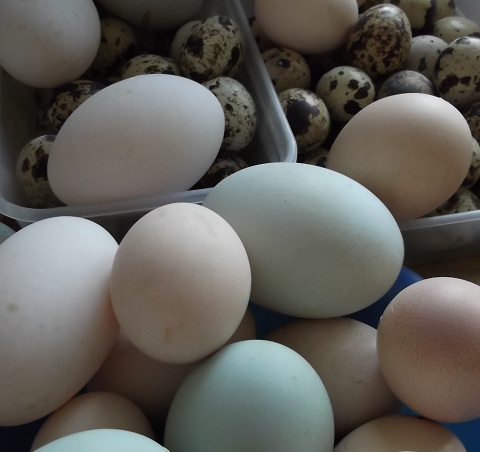
1 duck egg (from garden birds)
2 quail eggs (from garden birds)
60ml vegetable oil
65ml melted margarine (25p per tin from Approved Food*)
150g sugar
200g flour (Gluten free bread flour with sunflower and sesame seeds from Approved Food*)
25g cocoa powder 
Handful of raisins (optional) 
Half a teaspoon each of bicarbonate of soda and baking powder

 
Method
 
Beat the eggs, sugar and oil/margarine together, add the dry ingredients, then the grated courgettes, raspberries and sultanas, stir well.
 
Grease and/or line 2 x 2lb loaf tins or 1 x 10inch round cake tin.
 
Split the mix into the two tins if using the loaf tins, otherwise bake it all in the larger tin.
 
Bake at gas 4 / 180deg C for about 45 minutes, or until golden and a skewer comes out clean.
 
Leave to cool before slicing.
 
If you decide to try making courgette cakes, don't forget to photograph them and share your results with our frugal baking challengers in the forum that can be found here.
 
Owing to the fact that I had no self-raising flour and chose to use the gluten free bread flour, my loaves didn't rise as well as they may have. Having now cooled, I have sliced the first one, three of us have had a sample - it is extremely tasty and has a moist, sponge-like texture. The top photo shows a close up of the finished, sliced cake.
 
In a word, 'yummy'!
 
 
This is my entry into the Frugaldom Courgette Cake Challenge. I hope you all enjoy taking part this year.
 
Off for a coffee,
NYK in Frugaldom
 
 
* Friend referral links

Saturday, 6 July 2013

Back on the Trail of the Frugal Microholding (Part 2)

Getting to Grips with Permaculture

Part 2 of 3
 
Part one dealt with the bottom half of the Frugaldom garden, where there may one day be a productive little orchard and from where we are provided with our eggs from the hens and ducks. Part two is about how things are progressing and how well we can utilise the space we have that is both productive and in keeping with the principles of permaculture. This is my blackcurrant patch and the rhubarb is along the wall behind this.
 
For some reason, blackcurrants absolutely LOVE this garden and
are producing so much fruit that I may need to develop this into something a little more lucrative and self-sustaining than jam making. These bushes just haven't stopped growing, so I took hardwood cuttings (seen right of photo)and now these, too, are laden with ripening fruit. By the looks of things, there should be both blackcurrants and blackcurrant bushes available for sale later this year. To give you an idea of how productive these bushes are, I have sufficient jam to last me the next two years plus several kilos still in the freezer from last autumn's crop. Orders can be taken now if anyone would like any. With luck, I may even still have a record of what types they are - I know these earlier cropping ones all originate from my Ben Connans.

I have a shed where I house a few quail for eggs - a delicacy that we afford ourselves owing to the fact that the birds are relatively inexpensive to keep and that I, one day, would really like to develop that aspect of the microholding further, but other things have taken priority. Alongside the shed I have this 'spare' patch of ground, bordered by more raspberries and gooseberries. This is the patch that will feature in my next blog post, as a final decision has been made about what to do here to make it as productive as possible. There's no soil, as such, and last year's attempts to grow anything in it failed miserably. All we succeeded in doing was feeding the slugs, snails and sawflies, which have completely stripped my gooseberry bushes this year, again!

You all know how much I love my herb spirals and my circular gardens - they are all just so productive, easy to build and easy to maintain, so I now have four of them! I have two spirals and two circular beds of varying sizes and each is as productive as the next. Obviously, the first one built a year ago is ahead of the others, but they will soon catch up and become self-sustaining.

On the right, you can see the first one we built last May/June. The sage has been left to flower and last year's strawberry runners are filling up the gaps nicely!

Next I have the circular beds - one large one next to the first spiral and one smaller one linked to the patio area. Both are thriving in very different ways and both have been integrated with bird feeding stations.

This is the larger of the two, planted with assorted herbs, including one of my personal favourites, lemon balm - a type of mint. I also planted a cutting of lemon thyme in this bed, a gift from a fellow frugaler, so it's a place that the midges don't tend to frequent.

The lemon balm is great for its citrus scent and as the basis for a cup of lemon tea. Even daughter appreciates fresh lemon balm mint tea. Many cuttings will be propagated from this spiral bed so I have them available for trading at a later date. Indeed, all of the herbs growing in it at present have come from cuttings elsewhere. In the background, you can see my 'bug hotel' alongside two small square raised beds. The above photo shows the newest addition - the second spiral bed is now showing signs of coming to life with mint, basil and rosemary.

This is the bug hotel as it looks now. The main frame of the structure is built from an old wrought iron clothes rail, which has been built up with bits of concrete blocks, bricks, logs, pieces of pipe, plastic drinking straws, mesh and all manner of things found lying about the garden. An old piece of felt was used to cover a bit of board as a roof for it all and this now doubles as a shelf, where I can sit the pots of cuttings.

The honeysuckle has now wound its way around the top of the frame and is beginning to bloom. The little wooden box at top left is a butterfly box, a cheap bargain discounted item bought from an Aldi store. I don't think we have managed to attract any butterflies in there yet, though.

The two raised beds were purchased new while reduced in an online sale - bought via Topcashback to give me just that - cash back that converted into Amazon vouchers to give me a further 5% value. These were used in last year's Biochar experiment but I failed to see any difference between using the biochar and not. It's still in the box at the left, where you can see that my cabbages and sprouts are needing moved. The largest patch of greenery is a rogue Nasturtium and a sunflower that must have been dropped by a passing bird. The bracken fern behind it should really get pulled out but it seems to keep the slugs off the seedlings. I really need to get these seedlings thinned out as there are carrots in there, too. On the right, are my spring onions and a row of all year round cauliflowers that will also need transplanting very soon!

Despite me saying these were only going to be temporary, my plan being to improve the beds and get back to square foot gardening this year! Now look at it - two full beds of spuds that now need banking up with even more soil and compost, mixed with whatever else I can get my hands on, as soil isn't something we have much of about here. I am already regretting having potatoes in here taking up all this space. There are more potatoes sprouting in the micro-orchard among the edible hedging after we must have missed some of the potatoes there last year!

This is the polythene greenhouse that I was built last year. It's made from 2" x 2" and whatever bits and pieces of wood and board were left over from having the out-building renovated. I can easily walk in and out of it but anyone taller than me (most are) needs to duck down to get inside. Suits me just fine for pottering about, although it doesn't allow much growing space by the time the potting table is in it. The tomato seeds went straight into the ground but I don't know if they will grow quickly enough to produce fruit.

The green box alongside is my posh wormer, bought with my £2

 
coin savings pot last year. The worms have multiplied and I have hundreds of babies in there now, plus it is producing plenty of that wonderful worm juice fertiliser. My grand children think their granny is crazy for keeping pet worms, but that doesn't stop them from feeding said worms while here visiting!

Finally, to round off part 2 of this three-part post, this is the old aviary cage we got around 10 years ago. We no longer use it for finches, so it has been lying in pieces out in the shed at the bottom of the garden. Looking at it, I thought to myself, what better way to support the beans and peas than to get them to grow up the cage while waiting for it to become an integral part of the permaculture garden? I have several plants to train up and over this, which will also house bird nest boxes inside it to protect any little visitors from the cat! At the moment, I have beans in troughs on two sides and will have peas on the other two sides, but I am sure the Russian Vine, ivy and honeysuckle cuttings will be well established by next year, turning this into a piece of environmental art as part of our eco-arts project!

Now that we have reached the end of part 2 of these 3 significant posts, I hope you wont mind my ploughing on with the third. I think it's the most exciting part!

Frugaldom.

Sunday, 7 October 2012

Some Frugal Experimentation with Eggs

WINTER PREPARATIONS

With the approach of winter and the long, dark nights, anyone who keeps hens, ducks or quail will be all too aware of the fact that the egg laying diminishes to a virtual standstill, so it's time to make the most of whatever is available before we have no daily supply.

Normally, I'd have access to a proper kitchen to enable me to bake plenty of quiche, make lemon & lime curd and have a stock of meringues, assorted cakes and biscuits in store. However, Thrift Cottage doesn't, yet, have a kitchen, so some alternative storage methods have had to be employed for winter food supplies.

Egg storage is all quite new to me, as where we previously lived enabled me to sell any surplus, but making them last all year round was never given a thought - we simply did without them and made the most of whatever had been cooked up and popped into the freezer beforehand. Now,having read up on it, there seems to be no reason why we shouldn't freeze the eggs for defrosting and cooking when required. So that's what I'm in the process of doing.


Using a silicone muffin tray, I am cracking one duck egg into each section and then open freezing them. It's still at experimentation level for me, as I don't know how these will cook once defrosted, but the freezing seems to be working alright, allowing me to pop out each egg once it's done. They are curious looking 'cakes', that's for sure!
These frozen duck eggs are being bagged up and sealed, so they can be easily accessed individually, depending on how many are called for at any given time. Biscuit baking calls for only one at a time, so this seemed like the obvious solution to a winter egg shortage problem - we can at least have biscuits, cakes, pasta and quiche. That's the plan - I'll update you once I've got to the stage of needing to use any of them. I reckon the sections in the muffin tray will hold either one duck egg, 2 hen eggs or at least 4 quail eggs each.
 
If anyone else already does this, please get in contact and let me know if there's anything special I should know before defrosting and cooking these. In the meantime, wish me luck in my endeavours to keep a supply of garden dwelling poultry produced eggs going until spring, when the birds will, hopefully, all start laying again.
 
Join us in the Frugaldom Forums at http://frugaldom.myfreeforum.org if you are interested in participating in any of our 2013 moneysaving challenges. Frugal living and frugal working can work and it needn't mean doing without anything, assuming you concentrate on becoming debt free as your first priority. It's also a great way of finding new hints and tip about cost-cutting and reducing your spending, none more so than at home.
 
You can also follow @Frugaldom on Twitter.
 
Gve me a shout out if you spot Frugaldom anywhere else and have fun preparing for winter and the start of 2013.

Saturday, 17 September 2011

The Rain Fell, the Ducklings Looked up in Amazement!

It's Never Too Wet for Ducks, it Seems.

We really haven't had anything to complain about, weatherwise, here in Frugaldom, but yesterday's downpour came as a bit of a shock, even to the ducklings.

One minute it was slightly breezy and overcast, the next we were hit by a torrential downpour - it was probaby the first serious rain that we've had since the ducklings went outside.

This was quite a site to behold!

Did the ducklings all run for cover and shelter from the deluge? No! They came running up to the gate, 9 heads tilted sideways, staring skywards and quacking at the falling rain!

QUAIL: One of the projects we are working on here in Frugaldom is that of establishing a small egg production unit with the quail. Have you ever tried to photograph a quail? They are not the easiest birds to get to sit still and smile for the camera! After much to-ing and fro-ing, I managed to get one half-decent shot out of my dozens of failed attempts, so we now have the face of 'Frugal Gourmet'.

She is a 2010, homebred, Italian quail hen. This colour variation of the Japanese coturnix quail is sometimes referred to as a Phoenix Golden quail, a far prettier name, in my opinion. Despite it being very pale, the colour is dominant when breeding in mixed colonies, so I'm expecting to end up with the majority of my homebred hens looking similar to this.

Yesterday, while outdoor work was seriously curtailed by the rain and kitchen work seriously curtailed by the array of tubs scattered across the floor catching the drips from the leaking roof, I finally got around to designing the labels for the quail egg boxes.

Aample labels have now been printed and we are getting ready to begin sales proper. (I've omitted part of the labelling for obvious reasons, but the new web page has been uploaded and we're almost good to go.)

At £1.95 per dozen, I see no problems in selling, trading or even exchanging these eggs for other things that we need. I'll probably make a couple of small improvements to the final labels but, for now, we have the face of 'Frugal Gourmet'.

The latest quail chicks are nearly four weeks old and are about ready for transferring outside to their new quarters. The hens among them should be laying before the end of October!

Last time around, I separated the white males from the females prior to collecting eggs. This will ensure we have sufficient unrelated stock for next year's breeding programme. With luck, we should be able to have at least a dozen hens laying each day to see us through winter, then we'll set to work on improving the set-up to enable a larger flock to be maintained on a self-financing basis from 2012.

We aren't here to make our fortune, we are here to sustain our own lifestyle. If the birds can pay for themselves and supply us with eggs, I'll be delighted. Anything extra is a bonus that will be swept into savings for the next step of our Frugaldom journey.

Quail eggs for breakfast, anyone?

Sunday, 4 September 2011

Selling Quail Eggs for Hatching

I call my quail chicks fluffy bumble bees

Japanese Coturnix Quail chicks are tiny when they first hatch. They really are like fluffy bumble bees, buzzing about at high speed in the incubator before they're even properly dried.

Chickwatch, here in Frugaldom, isn't the male-dominated, sexist passtime you might suspect, it's more of an 'everyone wants to see what's happening inside the incubator' type of event.

It's understandable! Once you have observed these tiny chicks hatching from their tiny eggs, the whole process becomes both intriguing and fascinating.

What with the birth of grandaughter at New Year, followed by two months of feverish househunting, then the sudden decision to buy instead of rent, followed by another two months of trying to get this place habitable while managing a juggling act to move an entire garden, complete with poultry, I haven't had much time for hatching eggs in 2011. But that doesn't stop the ducks, hens, bantams or quail from laying.

I did manage to fit a dozen duck eggs into the incubator in June, so I now have 9 almost fully-grown ducklings running around the orchard with my adult birds.

Then I decided I needed more quail to bring the numbers up sufficiently to warrant regular egg sales, but I ended up selling most of those chicks to recoup the initial set-up costs for yet another project. So I left the quail hens and cockerels paired up and popped some more eggs into the incubator.

I now have another 9 healthy, multi-coloured quail chicks running around in a brooder box, sprouting feathers and starting to try and fly. This latest lot hatched on Tuesday 23rd August and I really, really hope this one on the left is a hen, as it is one of the most unusual colours I have ever seen.

The parents of my last chicks are still paired in their breeding cages and the hens are still laying eggs. I'd love to hatch out more chicks but don't want to risk setting up the incubator when major work is scheduled to start on the house this month. (It'll mean the power switched off for longish periods of time, not good for incubating eggs.) 

So... what does one do with extra eggs that are possibly fertile? After much debate, I listed them on eBid at 99p per dozen, with no reserve on selling price, that's what. They have a dedicated 'Poultry, Incubation and Hatching Eggs' section that not many people know about, yet.
For anyone who does not know about poultry and game, eggs are eggs are eggs. There are no chicks inside fresh eggs. They are deemed fertile ONLY because the hens that lay them are kept in the company of cockerels who may, or may not, be going about their natural business.

As eating eggs, they are no different to any other egg that you buy in a supermarket - you cannot tell the difference. However, no amount of care, attention and incubation will result in a chick growing inside a supermarket bought egg, so don't worry about that. I have been asked this question so many times! It is almost as common a question as being asked if hens lay eggs if there are no cockerels.

Yes, hens lay eggs regardless, you just can't get chicks out of their eggs, no matter how hard you try.

For transit, eggs are always well packed and are sent out through the Royal Mail system by whichever method buyers prefer.

If you are in or around the Dumfries & Galloway area, you are welcome to come and collect eggs to save on postage & packaging, which is charged at cost.

For hotels, restaurants or retailers, we welcome enquiries for regular supplies of fresh quail eggs. We sell these at £1.95 per dozen, discounts or trading exchanges always an option. (Yes, it is true, I do swap my quail eggs for other things, including chocolate!) Galloway LETS members pay 2 Crees per dozen.

If you have any questions about my quail, eggs or trading opportunities, please feel free to get in contact.

Thursday, 4 August 2011

Quail hatch in progress - STOP watching, GO and pick dinner!

Japanese Coturnix Quail Chicks in Assorted Colours.

Yes, this really is the second blog post of the day, but I need to keep certain people up to date with the hatching progress.

First of all, I find it very difficult not to sit watching proceedings but the eggs were left in the incubator this time, as opposed to being transferred into the hatching box, which has a viewing window. This means I've been unable to peer in, so had to keep myself otherwise amused for most of the afternoon.

Bread has been baked, freezer has been repacked to fit in today's order and numerous cups of tea have been enjoyed on the patio.

Some weeding got done, the duck pond got topped up, more eggs were collected (and sold to neighbours) and then it got really hot outside, so more sitting about on the patio. By that time, I could make out at least 7 chicks bumbling around inside the incubator, but I daren't open the lid at that stage as the sudden drop in temperature and humidity can affect the rest of the hatch.

Outside, I cleared and swept a small space under the kitchen window, repotted some plants, planted the first of the strawberry runners into individual pots, sowed another row of peas (can but try) and then potted up all my herb cuttings.

From left to right, I don't know what the first plant is, the second one grew from wildbird seed, the third is Thai Basil, next it's the parsley seedlings and then the rosemary, which I rooted from sprigs I bought reduced to 10p in the supermarket.

 The herb cuttings are an assortment of three types of mint - common, lemon balm and grapefruit - two types of thyme and several cuttings from my hardy curry plant that survived the -10C winter last year.

If I can get all of the above to develop into healthy plants, these will go into planters and get sat out on the little cobbled yard at the front of the house.

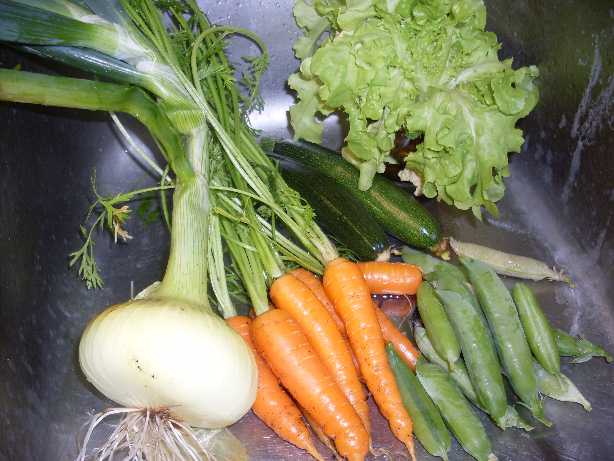
Dinner time arrived, so I did the frugal act of pulling some carrots and picking some peas. I also brought in some lettuce, a couple of courgettes and an onion, as I was desperate to see how these were doing.

As you can see by the photos, the onions are doing really well and are quite huge, considering how late the sets went in and the fact that the person who gave me them thought they'd be past their sell by date. Not in the least! These are growing great guns! I can hardly wait to pull them up and get them dried for winter use. This one will be going into tomorrow's spicy stir fry along with the courgette and some homegrown chilli peppers.

So, has anyone tried to count the quail chicks in the photograph? I can see 12, so am really happy that we've managed to achieve over 40%  Even I am surprised at how many of these eggs are hatching, as they were neither stored correctly, nor turned daily prior to being incubated. These were simply surplus to requirement eggs that I decided to set in the off chance that a couple of them might be fertile. :)

Nice result, so far.

Wednesday, 27 July 2011

Interesting Creepy Crawlies & Some Extra Space

Another Day for Shorts, T-shirts and Factor 50

For those of you who have followed the Frugaldom story over the past few years, you'll know that space has always been at a premium while we rented an assortment of cheaper properties while pursuing the goal of saving to buy a place to call home.

Where we are now is ideal. It has a long, walled patch of land, plenty of space for the feathered friends and a stream running through the bottom of the garden. But what amazes me the most (I'm incredulous, if truth be told) is the huge difference in climates between here and the previous house, less than 20 miles away.

I do realise that many parts of the UK are currently being bathed in scorching sunshine, but Scotland isn't particularly prone to extended periods of blistering heat: the novelty of photographing the thermometer by the back door, which isn't in direct sunlight, hasn't worn off, yet.

So here we are, stewing in 28C without knowing what the temperature is in the exposed part of the garden, not a breath of wind and a sky so blue that it looks like a well painted ceiling. The house has an easterly aspect to the front, so gets plenty of sunshine from just after dawn until early afternoon. I have a couple of pots and window boxes out there, but have been quite reserved in creating anything more, as the house sits right on the main street with no garden to speak of. Or so I thought...

Today I mustered up the courage to phone the council and roads department to clarify the situation and have now had the call back to confirm that we DO own the front patch of land that stretches the width of the house out to the main road.

This is BRILLIANT news! We now have another 28 (or thereabouts) square metres of space to call our own. This provides quite a large area for transforming into a potted garden - pots, planters and troughs - and maybe even some trellis for honeysuckle or climbing roses. (We could use part of it for off road parking, but that's not an option I want to take.)

This 'new' garden. actually goes out a bit further than can be seen here, but I couldn't be bothered moving the car to take a wider angled photo. :) Now another challenge begins - to create something worth looking at on a budget of not a lot. I've already got the seats and a couple more planters at the door and I now have all sorts of plans for creating a much more garden-like look. But I'll be needing some bulbs for all the planters I'm thinking of moving there soon. I could probably grow some edible stuff in this extra frugal space.

Our 'tropical' weather seems to bring out all sorts of creepy crawlies. There are plenty of lizards that sunbathe on the walls and fences and we've all moved away from the assortment of bees and biting 'things', but the arrival of the woodwasp that decided to hang around the back garden for a bit sent everyone running for cover, even the cat! These things are HUGE! At first we thought it was a giant wasp of the nasty, aggressive type but a quick search on Google confirmed its identity as a wood wasp.


Today's flying visitor was some sort of dragon fly. It's been hovering around the garden for the past day or two, looking like a remote controlled micro-helicopter! I haven't got too close to it but it looks to be about 7cm (ish) in length. If anyone knows what type of crittur this is, please let me know.

There have been several different dragon flies around, some of the blue ones, red ones and now this monster. It seems to like sunbathing on the garden wall but I'm wondering if us having dug the pond will encourage anything more 'exotic' into the garden.

The heron has been back for another look in the pond, must be hoping we stock it with fish! There have beem no further problems with the hawk since we relocated the quail from their outdoor run and, so far, the foxes have stayed on the other side of the wall, or else across the road in the field.

This morning, I reintroduced a couple of the male quail to the females - one male to 3 females. This should ensure I have a few fertile eggs for going into the incubator next weekend. There are already eggs incubating, but these were just what was collected from the hens when they got brought inside from their run. None of the eggs were weighed or candled, it's too difficult to see through their dark, mottled shells. I'm not expecting too many (if any) to hatch, but it would be nice to get a few.

Project Quail has well and truly begun. The new egg boxes have arrived, so the labels now need to be designed and printed for future use. I'm hoping to have this all up and running within the next couple of months, when I'll be able to offer surplus quail eggs for sale in the hope that the project becomes self-sustaining. If anyone is interested in buying fertile eggs, let me know and I'll list them in the Frugaldom store on eBid. Planning on selling them at £1.95 per dozen (plus p&p).

Well, that's about all the news for now - I'm popping back out to get more weeding done at the front, as I'm determined to clear out the ancient cobbled gully. There are a couple of tiny pansies (are they?) growing through, so I'll rescue them before hauling out the rest of the grass and weeds.

Daily updates are posted in the Frugaldom Forum, HERE. All comments welcome here and please feel free to make some suggestions for the frugaldom front patch.

Please correct me if I have the wrong names for any of the wild birds, flowers or creepy crawlies I write about - it's mainly guesswork.

Wednesday, 19 January 2011

An Eggs-cellent Frugal Business

January Sale Now On

I'd like one of these, please!
 2011, year three in Frugaldom and we're still pursuing the debt free, frugal living, frugal business, frugal blogging plan but now incorporating a frugal business plan for the future. Afterall, we still need to earn a living in order to pay all the bills.

There's no such thing as cash free living, no matter how much we want to believe it exists. In a nutshell, it doesn't!

Not wanting to carry all my eggs in one basket, making Frugaldom self-sufficient in all things, including cash, means diversification from ground level. There are no employees, there are no doors to be opened to allow the public access and there are no lengthy meetings or negotiations to fit into my day. What I do have is a small poultry flock that needs caring for from dawn until dusk, literally.

If you have any plans for keeping and rearing poultry or deriving part of your income from them, you'd probably be safest registering via Defra from the outset, get your flock onto the GB Poultry Register. At the moment, registration is voluntary for small keepers, but it is compulsory as soon as you reach 50 birds, including quail. Registration is completely free and it can be done online, so there's no excuse for not meeting minimum legal requirements once your flock is built up to a productive level. You'll also need to complete an annual questionnaire to confirm and/or update the numbers. This can also be done online.


Freerange eggs
Being of a frugal nature, keeping hens means that eggs become part of the staple diet. It's not just hen eggs we eat, there are also the duck and quail eggs, so there are always plenty on the go, especially once the better weather gets here. Birds usually need around 14 hours of daylight to produce eggs, but there are always a few appear through the winter. We've been really lucky in that we've managed to have an average of half a dozen per day right throughout the worst of the winter weather. The main problem was collecting quail eggs before they froze solid - something for which the cat was extremely grateful, as she got all the defrosted eggs.


Homemade Lemon Curd
 Spring will soon be creeping in and then egg production will soar. If the household can consume 40+ eggs per week then what happens when we're getting 100+ duck and hen eggs and another 100+ quail eggs?

There's a limit to what we can sell, especially as the law dictates eggs can only be sold directly to the consumer. There's all sorts of legislation governing eggs and egg sales, so best stick to selling directly to friends, neighbours, family and colleagues. Quail eggs, on the other hand, are a delicacy that can be traded retail or wholesale, to the consumer or hotels, restaurants and wholesalers.

Here in Frugaldom, I breed and rear Japanese Coturnix Quail mainly for eggs but it's the surplus eggs from the hens that get channelled into my small scale lemon curd production. I'm still tweaking the recipe to give it that 'something different' but feedback, so far, has been very positive for both the lemon and lime curds. I even make meringues and coconut macaroons in order to use up all the extra egg whites left over from using the bright yellow yokes.

But before you jump for joy and rush out to start making and plying your wares, one word of caution: In order to make and sell food, it is mandatory that you have a valid and current Food Hygiene Certificate. Your certificate needs renewing every 3 years. On the plus side, it costs only £25 and you can do the short course and sit the exam online within a few hours. As long as you are only making small quantities when you have surplus eggs, this project shouldn't need further certification for the premises. This is a handy publication (downloads as a .pdf) about starting a food-based business.

In the long run, I'd love to be able to build a Log Cabin and live the good life, but let's not try to run before we walk. In the meantime, if anyone has a scrap of land available for sale, please get in contact.

Tuesday, 18 January 2011

Life as a Frugal Entrepreneur: Self Sufficient Working

The Frugaldom understanding of self-sufficiency is one of self-sustainability. It's about earning your own living and then spending accordingly, living within your means, regardless of how great or how meagre these may be. It's a lifestyle choice. Frugaldom is freedom from debt by way of living and working in frugal ways.

Over the past few years we have organised various challenges relevant to moneysaving, clearing any debts and building a lifestyle that fits in with the whole ethos of sustainability. With a little bit of planning, this lifestyle can enbrace greener living or a more environmentally-friendly way of conducting business within the household and workplace. Frugaldom is about taking on the responsibility of providing for yourself and, hopefully, being able to share skills, goods and services in a way that can both benefit others and cover all associated costs.

True, cash free self-sufficiency, in my opinion, isn't legally possible within the UK. In order to live and work, we need shelter and that shelter incurs a tax. In order to live we need food and water - we could attempt to rear and grow all of our own food and pump our water from a well, but in order to do so there are welfare issues and legislation to be considered - these things cost money. We still need to earn and, as long as we earn, we need to pay taxes where and when due. Some might trade and barter or move around but, at the end of the day, everyone needs an income and earing that income costs money.

True Frugaldom means the ability to provide all things for the household in order to sustain a chosen lifestyle and afford everything that it entails. There should be no need for State hand outs but neither should there be an aversion to seeking financial help where and when genuinely needed.  In this respect, it is time to start building our self-sustainable business in order to help secure our future.  We are our own employers, without working (for ourselves) we can neither pay ourselves nor keep a business running.

On the surface, it's always handy to grow whatever fruit and vegetables you can, as everything you can produce from home is one less thing you need to spend money on, allowing you to focus your hard-earned cash elsewhere. Over the past few years we have documented the costs involved in setting up a garden to produce as much as possible, including eggs from the assorted poultry. We can make each micro-project self sustaining or cash-neutral; hens lay eggs, selling the surplus can pay for their keep. Quail lay eggs and are quickly hatched and reared - the sales of surplus birds and eggs can cover the costs. Cash generated from any source can be used to neutralise each of these individual budgets, each of these projects can be built up to combine into one business. It's what microholding is about - all these small, self-financing pieces of the jigsaw fitting together to form a much bigger picture - that picture is your business of the future.

Christmas and all the festivities have now passed and we're halfway through the first month of the new year. For those who are still relying on other people's money, the credit card and bank statements will be arriving, reminding you of the dire state of your finances. But not for all of us. For the debt free, each statement is a reminder that there is an alternative route, one that can and should be followed carefully if Frugaldom is to be achieved.

I have estimated that for every £1,000 it costs you to exist each year, you NEED to save £2.75 each and every day that you're not earning. So, if life is costing you £12,000 a year, you need to save £33 for every day that you won't be earning, weekends included. The figures are simple - the less life costs you, the less pressure you are under to earn or save extra.

Building a business isn't so different. Everything has to pay for itself, some things need to pay more to cover the inanimate objects that house them, some need to cover the cost of storage and distribution. In the case of gardening, plants need to cover the cost of the patch of land they take up each and every day it takes them to grow - fertiliser, protection from pests, time in planting, tending and harvesting... consider all costs, don't ever assume that because you did it that your time is completely free.

Any legislation governing what you do needs to be accounted for, just like the costs involved in owning a car to enable you to go about your daily life. If that car costs you £500 to have it parked in the driveway for 365 days of the year then that's almost £1.37 that needs to be earned every single day without even driving the car. (The figures get much bigger when you factor in the percentage that's needed to cover tax and National Insurance etc.) Only by analysing the true costs of living and working can we begin to understand the basic principles of self-sustainability and self-sufficiency. After 10+ years of lifestyle planning, 2011 is my year of Frugaldom business planning.

Fel free to follow Frugaldom on Twitter or join me in the Frugaldom Forums

Tuesday, 14 December 2010

QUAILS AND FROSTY WEATHER


If anyone ever tells you quail are lovely, simple to care for little gamebirds, remind them of how silly these feathered friends can be.

Having spent many weeks deliberating over the best way to keep mine - penned in a shed or space to run around outdoors - we eventually settled for building them an outdoor pen with a large sheltered platform. Quail are originally migratory birds, so they should not like the cold and they certainly shouldn't like the dampness followed by sub-zero temperatures. However...
My lovely little home-hatched, Japanese Coturnix Quail defy everything I've just said, so ignore it all. They don't hate the cold. Mine are hardy, Scottish quail. MacQuails, even!


Last night, it being such a clear, starry night, I wrapped up and went outdoors late to watch the Gemenids - meteors - that were flashing overhead. It was about 10.30pm, it was -5C and the sky was amazing, so I guess that must have been why all the quail were out runing about their pen! I could hear them chirping and gurgling that throaty noise they make when chasing one another. They were out playing in the freezing moonlight!

This morning, I peered anxiously into the run half expecting to see stiff little feathered bundles frozen to the ground but oh no, that wasn't what my quail were doing, they were dust bathing in their shavings inside the shelter and there were eggs lying OUTSIDE, FROZEN TO THE GROUND! Lifting them out, I could clearly see that the eggs were frozen solid, they had expanded and had split their shells from end to end. No wonder the Frugaldom cat likes meal time... I'd to thaw the eggs in her porridge so she didn't miss her fresh quail egg breakfast.

How does the saying go? Toffs are careless? Frugal living does have some luxurious side effects besides helping you remain debt free.


Join us in the fun, frugal forum at
http://www.frugaldom.co.uk/